How it works
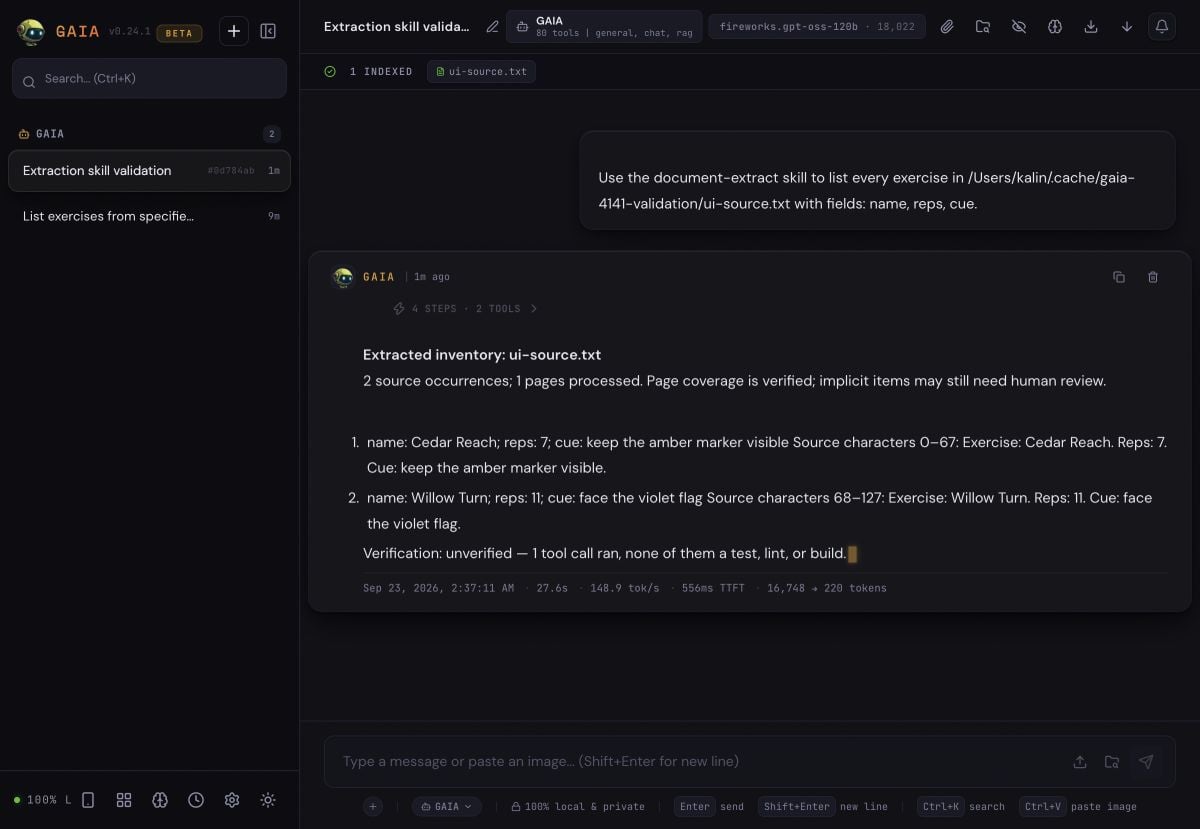
The default skill routes the task todocument-extract. GAIA reads small,
overlapping sections sequentially and checks each section again for omissions.
Each retained item includes the requested fields, an exact source quotation,
and character positions. A missing field is marked not stated.
The framework appends the retained inventory to GAIA’s answer, so the answer
can add analysis but can never condense forty extracted items into fifteen. For a requested file,
the exporter writes that same inventory as JSON, CSV, or readable text and checks
the saved contents before reporting completion.
Full page coverage does not guarantee that a model recognized every implicit
item. Review ambiguous passages and compare against a known item count when one
is available. When two extractions might be the same item, both are kept and the
later one is marked “(may repeat item N)” for you to check. Failed pages, denied
access, changed sources, and exceeded limits are reported as incomplete.
Memory and follow-ups
Outside private mode, existing memory records the extraction action, source fingerprint, coverage, count, and final answer. Long extraction answers are kept as one bounded conversation record so later items remain searchable. Ask GAIA to search past conversations for details from a previous inventory. A remembered inventory describes the earlier source. GAIA must revalidate the current file before using it as evidence that a new extraction task is complete. Private mode suppresses memory persistence.Limits and validation
Each source is limited to 256,000 characters, 512 occurrences, 100,000 characters of retained item text and quotations, and 30 minutes of extraction time. Saved conversation records are limited to 256,000 characters; a longer answer is not saved to memory, and GAIA logs an error. Other limits end the extraction as incomplete. The backend must support JSON-schema responses; the Claude provider ignores the schema, so there each page relies on the prompt alone. Small local models can take around 17 minutes for a 40-item, 79K-character document. Two passes per page require at least 40 calls at that size; retries and slower models can exceed the 30-minute deadline. Developers can run the repeatable live benchmark with either a local model or a configured Fireworks model:--unlined
variant has no line breaks and starts with an entire page containing no items,
matching the format of transcription output.